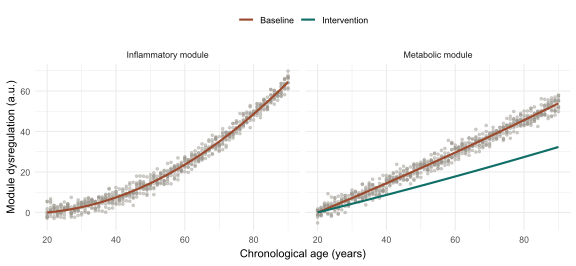
If ageing is corrupted epigenetic information, the therapeutic logic is to rewrite it — and unlike the genome, the epigenome is designed to be written. Three approaches follow, and the rest of Part III elaborates them. The most radical is epigenetic reprogramming, the controlled, pulsed application of identity factors to restore youthful patterns of expression, whose central problem is one of dosage and control (Section 8.2) and whose mechanism is precisely the reset this chapter has described. More conventional are the epigenetic drugs — inhibitors of the methyltransferases and histone deacetylases that already exist, largely from oncology, as agents for redirecting a cell’s expression programme (Marei, 2025). And on the horizon is targeted epigenetic editing, which would rewrite specific marks at specific loci rather than resetting the cell wholesale. All three rest on the same foundation laid here: that the layer ageing corrupts is the one layer cells were built to revise.
Belsky, D. W., Caspi, A., Corcoran, D. L., Sugden, K., Poulton, R., Arseneault, L., Baccarelli, A., Chamarti, K., Gao, X., Hannon, E., Harrington, H. L., Houts, R., Kothari, M., Kwon, D., Mill, J., Schwartz, J., Vokonas, P., Wang, C., Williams, B. S., & Moffitt, T. E. (2022).
DunedinPACE, a
DNA methylation biomarker of the pace of aging.
eLife,
11, e73420.
https://doi.org/10.7554/eLife.73420
Ciaglia, E. et al. (2025). The genetic and epigenetic arms of human ageing and longevity.
Biology,
14(1), 92.
https://doi.org/10.3390/biology14010092
Gems, D., & Magalhães, J. P. de. (2024). Epigenetic clocks and programmatic aging.
Ageing Research Reviews,
101, 102546.
https://doi.org/10.1016/j.arr.2024.102546
Hannum, G., Guinney, J., Zhao, L., Zhang, L., Hughes, G., Sadda, S., Klotzle, B., Bibikova, M., Fan, J.-B., Gao, Y., Deconde, R., Chen, M., Rajapakse, I., Friend, S., Ideker, T., & Zhang, K. (2013). Genome-wide methylation profiles reveal quantitative views of human aging rates.
Molecular Cell,
49(2), 359–367.
https://doi.org/10.1016/j.molcel.2012.10.016
Horvath, S. (2013).
DNA methylation age of human tissues and cell types.
Genome Biology,
14(10), R115.
https://doi.org/10.1186/gb-2013-14-10-r115
Levine, M. E., Lu, A. T., Quach, A., Chen, B. H., Assimes, T. L., Bandinelli, S., Hou, L., Baccarelli, A. A., Stewart, J. D., Li, Y., Whitsel, E. A., Wilson, J. G., Reiner, A. P., Aviv, A., Lohman, K., Liu, Y., Ferrucci, L., & Horvath, S. (2018). An epigenetic biomarker of aging for lifespan and healthspan.
Aging,
10(4), 573–591.
https://doi.org/10.18632/aging.101414
López-Otín, C., Blasco, M. A., Partridge, L., Serrano, M., & Kroemer, G. (2013). The hallmarks of aging.
Cell,
153(6), 1194–1217.
https://doi.org/10.1016/j.cell.2013.05.039
López-Otín, C., Blasco, M. A., Partridge, L., Serrano, M., & Kroemer, G. (2023). Hallmarks of aging: An expanding universe.
Cell,
186(2), 243–278.
https://doi.org/10.1016/j.cell.2022.11.001
Lu, A. T., Fei, Z., Haghani, A., Robeck, T. R., Zoller, J. A., Li, C. Z., Lowe, R., Yan, Q., Zhang, J., Vu, H., et al. (2023). Universal
DNA methylation age across mammalian tissues.
Nature Aging,
3(9), 1144–1166.
https://doi.org/10.1038/s43587-023-00462-6
Lu, A. T., Quach, A., Wilson, J. G., Reiner, A. P., Aviv, A., Raj, K., Hou, L., Baccarelli, A. A., Li, Y., Stewart, J. D., Whitsel, E. A., Assimes, T. L., Ferrucci, L., & Horvath, S. (2019).
DNA methylation
GrimAge strongly predicts lifespan and healthspan.
Aging,
11(2), 303–327.
https://doi.org/10.18632/aging.101684
Lu, Y., Brommer, B., Tian, X., Krishnan, A., Meer, M., Wang, C., Vera, D. L., Zeng, Q., Yu, D., Bonkowski, M. S., et al. (2020). Reprogramming to recover youthful epigenetic information and restore vision.
Nature,
588(7836), 124–129.
https://doi.org/10.1038/s41586-020-2975-4
Marei, H. E. (2025). Epigenetic regulators in cancer therapy and progression.
Npj Precision Oncology,
9(1), 206.
https://doi.org/10.1038/s41698-025-01003-7
Meyer, D. H., & Schumacher, B. (2024). Aging clocks based on accumulating stochastic variation.
Nature Aging,
4(6), 871–885.
https://doi.org/10.1038/s43587-024-00619-x
Sen, P., Shah, P. P., Nativio, R., & Berger, S. L. (2016). Epigenetic mechanisms of longevity and aging.
Cell,
166(4), 822–839.
https://doi.org/10.1016/j.cell.2016.07.050
Tong, H., Dwaraka, V. B., Chen, Q., Luo, Q., Lasky-Su, J. A., Smith, R., & Teschendorff, A. E. (2024). Quantifying the stochastic component of epigenetic aging.
Nature Aging,
4(6), 886–901.
https://doi.org/10.1038/s43587-024-00600-8
Tyshkovskiy, A., Kholdina, D., Davitadze, M., Molière, A., Moldakozhayev, A., Tongu, Y., Kasahara, T., Glubokov, D., Eames, A., Kats, L. M., Vladimirova, A., Ying, K., Liu, H., Zhang, B., Khasanova, U., Moqri, M., Van Raamsdonk, J. M., Harrison, D. E., Strong, R., … Gladyshev, V. N. (2026). Universal transcriptomic hallmarks of mammalian ageing and mortality.
Nature.
https://doi.org/10.1038/s41586-026-10542-3
Yang, J.-H., Hayano, M., Griffin, P. T., Amorim, J. A., Bonkowski, M. S., Apostolides, J. K., & Sinclair, D. A. (2023). Loss of epigenetic information as a cause of mammalian aging.
Cell,
186(2), 305–326.e27.
https://doi.org/10.1016/j.cell.2022.12.027
Yücel, A. D., & Gladyshev, V. N. (2026). Systemic epigenetic dysregulation as a driver of ageing and a therapeutic target.
Nature Reviews Molecular Cell Biology.
https://doi.org/10.1038/s41580-026-00958-0