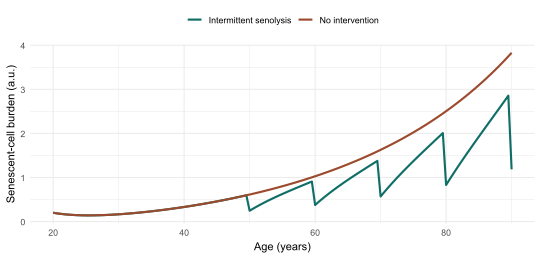
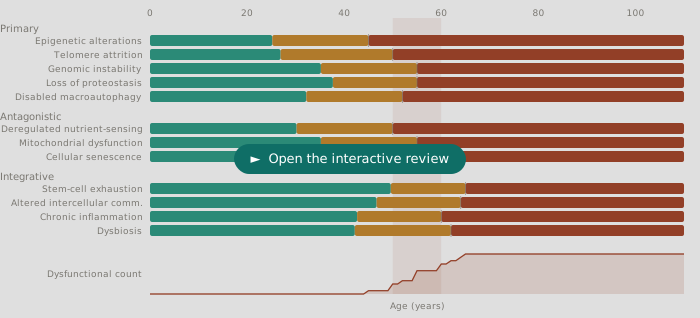
We have followed a single cascade across three tiers of the hallmarks framework: a primary clock running down at the chromosome’s ends, an antagonistic state that saves cells from cancer and then poisons the tissue around them, and an integrative inflammation that may be less universal than its prominence suggests. At each step the same caution recurred — that these processes are protective before they are pathological, so that the obvious intervention is rarely the safe one, a theme that will shape the therapeutic chapters of Part III.
But why do telomeres fray faster in some lives than others, why do cells tip into senescence, and what feeds the inflammation once it starts? The answers lead inward, to the cell’s metabolism and its systems of quality control — how it senses nutrients, folds and disposes of its proteins, and recycles its own worn parts. These are the processes whose decline underlies much of what we have just described, and whose deliberate manipulation, through the oldest and most reproducible of all longevity interventions, opens the next chapter.
Baker, D. J., Wijshake, T., Tchkonia, T., LeBrasseur, N. K., Childs, B. G., Sluis, B. van de, Kirkland, J. L., & Deursen, J. M. van. (2011). Clearance of p16
Ink4a-positive senescent cells delays ageing-associated disorders.
Nature,
479(7372), 232–236.
https://doi.org/10.1038/nature10600
Bernardes de Jesus, B., Vera, E., Schneeberger, K., Tejera, A. M., Ayuso, E., Bosch, F., & Blasco, M. A. (2012). Telomerase gene therapy in adult and old mice delays aging and increases longevity without increasing cancer.
EMBO Molecular Medicine,
4(8), 691–704.
https://doi.org/10.1002/emmm.201200246
Demaria, M., Ohtani, N., Youssef, S. A., Rodier, F., Toussaint, W., Mitchell, J. R., Laberge, R.-M., Vijg, J., Van Steeg, H., Döllé, M. E. T., Hoeijmakers, J. H. J., Bruin, A. de, Hara, E., & Campisi, J. (2014). An essential role for senescent cells in optimal wound healing through secretion of
PDGF-AA.
Developmental Cell,
31(6), 722–733.
https://doi.org/10.1016/j.devcel.2014.11.012
Ferrucci, L., & Fabbri, E. (2018). Inflammageing: Chronic inflammation in ageing, cardiovascular disease, and frailty.
Nature Reviews Cardiology,
15(9), 505–522.
https://doi.org/10.1038/s41569-018-0064-2
Franceschi, C., Bonafè, M., Valensin, S., Olivieri, F., De Luca, M., Ottaviani, E., & De Benedictis, G. (2000). Inflamm-aging: An evolutionary perspective on immunosenescence.
Annals of the New York Academy of Sciences,
908, 244–254.
https://doi.org/10.1111/j.1749-6632.2000.tb06651.x
Franck, M., Tanner, K., Tennyson, R., Daunizeau, C., Ferrucci, L., Bandinelli, S., Trumble, B., et al. (2025). Nonuniversality of inflammaging across human populations.
Nature Aging,
5, 1471–1480.
https://doi.org/10.1038/s43587-025-00888-0
Friedrich, M. J. et al. (2026). Transient hepatic reconstitution of trophic factors enhances aged immunity.
Nature,
650(8101), 481–489.
https://doi.org/10.1038/s41586-025-09873-4
Gorgoulis, V., Adams, P. D., Alimonti, A., Bennett, D. C., Bischof, O., Bishop, C., Campisi, J., Collado, M., et al. (2019). Cellular senescence: Defining a path forward.
Cell,
179(4), 813–827.
https://doi.org/10.1016/j.cell.2019.10.005
Hayflick, L., & Moorhead, P. S. (1961). The serial cultivation of human diploid cell strains.
Experimental Cell Research,
25(3), 585–621.
https://doi.org/10.1016/0014-4827(61)90192-6
Iskandar, M., Xiao Barbero, M., Jaber, M., Chen, R., Gomez-Guevara, R., Cruz, E., & Westerheide, S. (2025). A review of telomere attrition in cancer and aging: Current molecular insights and future therapeutic approaches.
Cancers,
17(2), 257.
https://doi.org/10.3390/cancers17020257
Jiang, M., Xu, Q., & Wu, Z. (2026). Optimized yamanaka factors combined with TERT gene therapy for enhanced anti-aging effects.
Genes & Diseases,
13(2), 101669.
https://doi.org/10.1016/j.gendis.2025.101669
Jinesh, S., Özüpek, B., & Aditi, P. (2025). Premature aging and metabolic diseases: The impact of telomere attrition.
Frontiers in Aging,
6, 1541127.
https://doi.org/10.3389/fragi.2025.1541127
López-Otín, C., Blasco, M. A., Partridge, L., Serrano, M., & Kroemer, G. (2013). The hallmarks of aging.
Cell,
153(6), 1194–1217.
https://doi.org/10.1016/j.cell.2013.05.039
López-Otín, C., Blasco, M. A., Partridge, L., Serrano, M., & Kroemer, G. (2023). Hallmarks of aging: An expanding universe.
Cell,
186(2), 243–278.
https://doi.org/10.1016/j.cell.2022.11.001
López-Otín, C., & Kroemer, G. (2024). The missing hallmark of health: Psychosocial adaptation.
Cell Stress,
8, 21–50.
https://doi.org/10.15698/cst2024.03.294
McLoughlin, M. A. et al. (2025). Telomere attrition becomes an instrument for clonal selection in aging hematopoiesis and leukemogenesis.
Nature Genetics,
57(9), 2215–2225.
https://doi.org/10.1038/s41588-025-02296-x
Muñoz-Espín, D., Cañamero, M., Maraver, A., Gómez-López, G., Contreras, J., Murillo-Cuesta, S., Rodríguez-Baeza, A., Varela-Nieto, I., Ruberte, J., Collado, M., & Serrano, M. (2013). Programmed cell senescence during mammalian embryonic development.
Cell,
155(5), 1104–1118.
https://doi.org/10.1016/j.cell.2013.10.019
Trastus, L. A., & Fagagna, F. d’Adda di. (2025). The complex interplay between aging and cancer.
Nature Aging,
5(3), 350–365.
https://doi.org/10.1038/s43587-025-00827-z
Wang, N. et al. (2023). Targeting epigenetic regulators to overcome drug resistance in cancers.
Signal Transduction and Targeted Therapy,
8(1), 69.
https://doi.org/10.1038/s41392-023-01341-7
Youssef, K. K., & Nieto, M. A. (2024). Epithelial–mesenchymal transition in tissue repair and degeneration.
Nature Reviews Molecular Cell Biology,
25(9), 720–739.
https://doi.org/10.1038/s41580-024-00733-z
Yücel, A. D., & Gladyshev, V. N. (2026). Systemic epigenetic dysregulation as a driver of ageing and a therapeutic target.
Nature Reviews Molecular Cell Biology.
https://doi.org/10.1038/s41580-026-00958-0