8  Reprogramming: Reversing Cellular Age

The boldest claim in the whole field is not that ageing can be slowed, or its damaged cells cleared, but that it can be reversed — that a cell’s age can be rewound while its identity is kept intact. This chapter asks how, how far, and at what risk.

Every strategy so far has accepted the direction of time. Dietary restriction slows the accumulation of damage; senolytics subtract the cells that damage has ruined. Reprogramming proposes something categorically different: to reach into a cell that has drifted with age and restore the molecular pattern of a younger one — not to slow the clock, nor to remove the cells that the clock has spoiled, but to turn the clock back. If ageing is, as the epigenetic chapters argued, a corruption of the cell’s regulatory information rather than its genetic text, then in principle that information can be rewritten. This chapter is about the attempt.

The intellectual foundation was laid long before anyone thought of ageing. In 2006, Takahashi and Yamanaka showed that four transcription factors — Oct4, Sox2, Klf4 and c-Myc, the Yamanaka factors — could drive a fully differentiated adult cell all the way back to an embryonic-like pluripotent state (Takahashi & Yamanaka, 2006). The result demolished a dogma: cell identity, long believed to be a one-way descent down Waddington’s landscape, could be reversed. The cell could be pushed back up the hill. But complete reprogramming erases identity entirely — a skin cell becomes a stem cell, capable of becoming anything, and a mass of such cells in the body is a teratoma. For rejuvenation this is useless: a younger cell is no use if it has forgotten what it is. The audacious idea that defines this chapter is that the journey back up the hill passes through a zone in which a cell has shed its age but not yet its identity — and that if you stop there, you get rejuvenation without dissolution.

NoteKey concept — age and identity are two dials, not one

The central premise of partial reprogramming is that the age of a cell and the identity of a cell are separable properties, controlled by partly independent layers of the epigenome. Full reprogramming turns both dials at once: it resets age and identity back to the embryonic ground state. Partial reprogramming is the wager that the age dial can be turned down a long way before the identity dial begins to move — that a cell can be made transcriptionally and epigenetically younger while still “remembering”, through enhancer marks and residual gene expression, that it is a fibroblast or a neuron (Gill et al., 2022; Sarkar et al., 2020). Everything in this chapter — the choice of factors, the brevity of the pulse, the search for the precise withdrawal point — is an attempt to move one dial without disturbing the other. The therapy lives in the gap between the two.

8.1 The proof that age is reversible

The decisive demonstration came in 2016. Ocampo and colleagues engineered progeroid mice to express the four factors under chemical control and induced them not continuously but in short, repeated pulses — two days on, five days off. Cyclic induction ameliorated multiple age-associated hallmarks and extended the lifespan of these fast-ageing animals, and, crucially, the intermittent schedule avoided the tumours that continuous expression produced (Ocampo et al., 2016). This was the first evidence that partial reprogramming could rejuvenate a living mammal rather than a cell in a dish, and the cyclic logic it introduced has shaped the field ever since.

What followed sharpened both the reach and the safety of the approach. To reduce the cancer risk, Lu and colleagues dropped the oncogenic c-Myc and used only three factors (OSK); delivered to the eye, this restored youthful DNA-methylation patterns to retinal ganglion cells and regenerated the optic nerve, reversing vision loss in old mice and in a glaucoma model — explicitly tying rejuvenation to the resetting of the epigenetic clock of Section 3.3. Browder and colleagues then showed that long-term cyclic reprogramming could be applied to normally ageing wild-type mice, not just progeroid ones, shifting age-associated molecular markers without evident harm over the treatment period (Browder et al., 2022). And in human cells, the principle held: transient delivery of reprogramming factors by mRNA rejuvenated aged human fibroblasts, chondrocytes and muscle stem cells — resetting the epigenetic clock and restoring a youthful regenerative response — without abolishing cellular identity (Sarkar et al., 2020).

How far back can a cell be pushed before identity goes? The most precise answer came from a method built to find the edge. Gill and colleagues developed maturation-phase transient reprogramming, expressing the factors only until the point at which the epigenome begins to rejuvenate and then withdrawing them; applied to fibroblasts from middle-aged donors, it rolled the transcriptome and methylation age back by around thirty years, while the cells transiently lost and then reacquired their fibroblast identity (Gill et al., 2022). The same study reported that distinct optimal time windows exist for rejuvenating the transcriptome and the epigenome — the first quantitative map of the gap between turning down age and losing identity.

Why should age be reversible at all? The most influential answer is the information view introduced in Chapter 3. In the ICE mouse — engineered to accumulate epigenetic disruption without changing DNA sequence — driving the epigenome out of order was sufficient to age the animal, and partial reprogramming could reverse it, which suggests that ageing is a loss of epigenetic information rather than its irrecoverable destruction (Yang et al., 2023). The metaphor its authors favour is a backup copy: somewhere in the cell, a youthful pattern of gene regulation remains recoverable — a ground state — and reprogramming is the instruction to restore from backup. It is a beautiful idea, and an unproven one. Two cautions belong here. First, where the backup is physically held, and whether it truly survives intact into old age, is not established. Second, almost all the evidence above is read through ageing clocks, and a clock measures correlation, not function: an intervention can reset a methylation or transcriptomic clock without necessarily restoring what the tissue does, and some of the variation those clocks track may be stochastic rather than programmatic (Meyer & Schumacher, 2024). That a clock runs backwards is a powerful signal. It is not yet proof that a body has grown younger — a distinction Chapter 11 insists upon.

The reach of rejuvenation has since been confirmed by independent instruments. An imaging-based measure of chromatin and epigenetic age, read in single nuclei, falls after transient reprogramming in mouse liver and skeletal muscle (and after caloric restriction), giving single-cell resolution to a process previously inferred only from bulk clocks (Alvarez-Kuglen et al., 2024). And the rejuvenating effect is not confined to the four factors: a multi-omic study of partial chemical reprogramming — using small-molecule cocktails rather than transgenes — reduced the biological age of mouse fibroblasts across the transcriptome, proteome, metabolome and epigenome, with a notable restoration of mitochondrial function (Mitchell et al., 2024). That chemistry alone can do part of the job matters enormously for the clinic, for reasons the dosing problem makes clear.

8.2 The dosing problem: continuous versus cyclic induction, and spatiotemporal control

The promise of reprogramming is inseparable from its central danger, and the danger is cancer. When the four factors are expressed continuously and without restraint in a living mouse, cells reprogramme all the way to pluripotency in place, and the result is teratomas erupting from multiple organs — full reprogramming can occur in the body, with lethal consequences (Abad et al., 2013). Worse, the hazard does not require reaching pluripotency: even a brief, interrupted burst of the factors can leave cells trapped in a dysregulated intermediate state and drive cancers, including kidney tumours resembling paediatric Wilms tumour, through purely epigenetic changes — no mutation required (Ohnishi et al., 2014). Reprogramming, in other words, is dangerous both if it goes too far and if it stops in the wrong place.

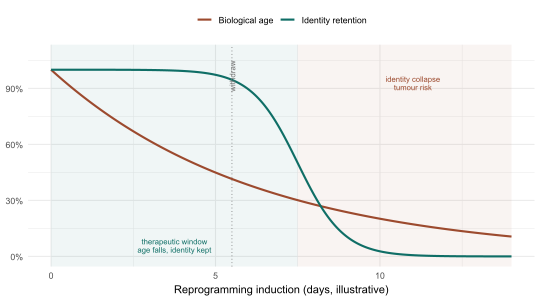
This is why dosing is not a detail but the whole problem. The therapeutic window mapped in the previous section has a cliff at its far edge, and a cell pushed past the maturation phase does not become usefully younger — it loses its identity and becomes a tumour seed. Figure 8.1 makes the trade-off concrete: biological age falls steadily as induction proceeds, but identity is retained only up to a threshold, beyond which it collapses. The art is to capture as much of the age reduction as possible while staying on the safe side of that line — and then to withdraw, before drifting over it.

Show the simulation code
library(ggplot2)

t     <- seq(0, 14, by = 0.05)   # induction time (illustrative days)
tstar <- 7.5                     # maturation-phase boundary: identity "point of no return"
tw    <- 5.5                     # withdrawal point for partial reprogramming (inside window)

age      <- exp(-0.16 * t)               # biological age: 1 (old) -> 0 (young)
identity <- 1 / (1 + exp((t - tstar)/0.7))  # identity retention: ~1, then collapses

df <- rbind(
  data.frame(t = t, value = age,      series = "Biological age"),
  data.frame(t = t, value = identity, series = "Identity retention")
)
pal <- c("Biological age" = "#9C4A2E", "Identity retention" = "#0F6E66")

ggplot(df, aes(t, value, colour = series)) +
  annotate("rect", xmin = 0,     xmax = tstar, ymin = -Inf, ymax = Inf,
           fill = "#0F6E66", alpha = 0.06) +
  annotate("rect", xmin = tstar, xmax = 14,    ymin = -Inf, ymax = Inf,
           fill = "#9C4A2E", alpha = 0.06) +
  geom_vline(xintercept = tw, linetype = "dotted", colour = "grey45",
             linewidth = 0.4) +
  geom_line(linewidth = 1) +
  annotate("text", x = tstar/2, y = 0.06,
           label = "therapeutic window\nage falls, identity kept",
           size = 2.7, colour = "#0F6E66", lineheight = 0.9) +
  annotate("text", x = 11.0, y = 0.93,
           label = "identity collapse\ntumour risk",
           size = 2.7, colour = "#9C4A2E", lineheight = 0.9) +
  annotate("text", x = tw, y = 1.05, label = "withdraw",
           angle = 90, hjust = 1, size = 2.8, colour = "grey45") +
  scale_colour_manual(values = pal) +
  scale_y_continuous(labels = scales::percent, limits = c(0, 1.08)) +
  labs(x = "Reprogramming induction (days, illustrative)",
       y = NULL, colour = NULL) +
  theme_minimal(base_size = 11) + theme(legend.position = "top")
Figure 8.1: The therapeutic window of partial reprogramming, simulated. As reprogramming factors are induced, the cell’s biological age falls (rust) — the longer the induction, the younger the epigenetic and transcriptomic profile. But identity retention (teal) holds near-complete only up to a threshold, the maturation-phase boundary, beyond which the cell loses its differentiated character and slides towards pluripotency and tumour risk (shaded rust). Partial reprogramming aims to withdraw the factors inside the safe window (dotted line): at this point much of the age reduction has been captured while identity is essentially intact. Push past the boundary and the small additional gain in youth is bought at the cost of identity itself. The curves are illustrative — real windows differ by cell type, factor set and delivery — but the shape is the point, and it is why every successful protocol is transient or cyclic rather than continuous.

Two families of solution follow from this geometry. The first is temporal: keep each exposure short and repeat it, so the cell repeatedly dips into the window and is pulled out before it can cross the line. This is the cyclic logic of Ocampo’s original protocol, and it is the direct counterpart of the intermittent, “hit-and-run” dosing of senolytics in Section 7.2 — both fields, for different reasons, converge on the same rhythm of brief intervention and withdrawal (Figure 4.1). The second is spatial: confine reprogramming to the cells that need it. A 2024 study delivered OSK by an adeno-associated virus under the control of a p16INK4a promoter, so that the factors switched on only in aged and stressed cells; in progeroid and in naturally aged mice this targeted approach extended lifespan and improved tissue function without increasing tumour incidence (Sahu et al., 2024). The two strategies address the same cliff from different sides — one limits how long, the other limits where.

Two Nobel proofs. That differentiation is reversible was shown twice, sixty years apart. In 1962 John Gurdon transplanted the nucleus of an adult frog gut cell into an egg and grew a whole tadpole, proving the genome of a specialised cell still holds the full instructions. In 2006 Yamanaka achieved the same reversal with four defined factors and no egg (Takahashi & Yamanaka, 2006). They shared the 2012 Nobel Prize. Reprogramming for rejuvenation is the third act: not erasing identity to start again, but borrowing the machinery to retreat only part of the way.

ImportantAnalogy — rewinding the tape, not erasing it

Think of a cell’s life as a cassette playing forward. Ageing is the tape advancing and, along the way, accumulating hiss and dropouts — the epigenetic noise of Chapter 3. Full reprogramming rewinds the tape all the way to the blank leader at the start: pristine, but with the recording gone. That is pluripotency, and in the body it is a tumour. Partial reprogramming is rewinding by a few tracks — far enough to get back before the hiss crept in, not so far that you pass the beginning of the song. The danger is that the rewind button has no precise counter: hold it a moment too long and you shoot past the first track into blank tape, losing the recording you were trying to clean. Cyclic dosing is tapping the button in short presses and checking after each; targeted delivery is rewinding only the cassettes that actually need it. Either way, the skill is knowing when to let go.

There is a final subtlety that links this chapter to the last. Damaged and senescent tissue is more permissive to reprogramming: the inflammatory secretions of senescent cells, interleukin-6 chief among them, create a local environment that lowers the barrier to in-vivo reprogramming (Mosteiro et al., 2016). This cuts both ways. It means an aged, inflamed tissue may reprogramme more readily than a young one — convenient — but also that the same senescence-associated signalling the previous chapter sought to clear is entangled with the very plasticity this chapter seeks to exploit. Senescence and reprogramming are not separate stories; they are two responses to damage that share a molecular neighbourhood.

8.3 From clock to identity: reversing the drift

It would be possible to read everything above as a story about clocks — about driving a methylation estimator downward. That reading misses what makes reprogramming the conceptual heart of this inquiry. The deeper claim, developed by the Izpisua Belmonte group, is that ageing is fundamentally a progressive loss of cellular identity: across tissues and species, ageing cells drift away from their specialised lineage programmes and towards a generic, partially mesenchymal state — the same slide towards epithelial–mesenchymal and endothelial–mesenchymal character met in earlier chapters, and a driver of the fibrosis that stiffens old organs. This mesenchymal drift is prevalent in ageing and disease, and partial reprogramming reverses it (J. Y. Lu et al., 2025). In a 2026 synthesis, the same group proposed mesenchymal drift as a convergent framework for the hallmarks of ageing: a common axis onto which many of the separate hallmarks project, both arising from them and reinforcing them, and therefore a single point of leverage (J. Y. Lu et al., 2026).

This reframes what reprogramming does. It is not merely turning a clock backward; it is restoring a cell’s grip on what it is supposed to be. Where dietary restriction slows the drift and senolytics remove the cells that have drifted furthest, reprogramming proposes to reverse the drift in cells that remain — to call a wandering fibroblast or endothelial cell back to its proper lineage identity, and in doing so to counteract several hallmarks at once rather than one at a time (Izpisua, 2026; J. Y. Lu et al., 2026). It is the only strategy in this literature that claims to do so. That ambition is also the source of its risk: a therapy powerful enough to rewrite cell identity is, by the same token, powerful enough to erase it.

8.4 Toward the clinic

The distance from a rejuvenated mouse to a treated human is governed almost entirely by the tumour problem, and the routes now being pursued are best understood as different ways of containing it. Table 8.1 sets out the main approaches against what each induces and the risk each must manage.

Table 8.1: Approaches to cellular reprogramming for rejuvenation, by what is induced and the risk each must contain. The progression from full to targeted, transient and chemical reprogramming is largely a progression in safety.
Approach What is induced Key evidence Principal risk or limit
Full reprogramming (iPSC) OSKM to pluripotency Foundational (Takahashi & Yamanaka, 2006) Erases identity; teratoma in vivo (Abad et al., 2013)
Cyclic in vivo OSKM Short repeated pulses Lifespan and hallmark gains (Browder et al., 2022; Ocampo et al., 2016) Tumour risk if prolonged or interrupted (Ohnishi et al., 2014)
OSK (c-Myc omitted) Three factors, safer set Vision restored; clock reset (Y. Lu et al., 2020) Slower, less complete reprogramming
Targeted (p16-driven) OSK only in aged/stressed cells Lifespan extended, no excess tumours (Sahu et al., 2024) Delivery; selectivity of the promoter
Transient mRNA Non-integrating, brief Rejuvenates human cells (Sarkar et al., 2020) Delivery; repeat dosing needed
Maturation-phase transient Withdraw at rejuvenation point ~30-year clock reversal in vitro (Gill et al., 2022) Defining the point; in vitro so far
Chemical cocktails Small molecules, no transgene Multi-omic age reversal (Mitchell et al., 2024) Mechanism unclear; specificity

Read down the table and a direction of travel appears: away from strong, integrating, whole-body induction and towards interventions that are briefer, more local, non-integrating, or chemical — each sacrificing some potency for safety. The same impulse drives interest in the safest clinical setting of all, in which the tumour risk is physically contained: ex vivo organ rejuvenation, in which a donor organ is reprogrammed on a perfusion machine outside the body, its age partly reversed before transplantation, with any aberrant growth detectable before the organ is ever implanted (Haoui et al., 2026). Reprogramming may reach the clinic first not as a systemic anti-ageing therapy but as a way to make a marginal donor kidney behave like a younger one. Other near-term routes are similarly bounded: localised delivery to a single tissue, as in the optic-nerve and neuronal studies where cyclic factor expression reversed age-associated phenotypes and improved memory in mice (Antón-Fernández et al., 2024; Y. Lu et al., 2020), and combination designs that pair reprogramming with telomere maintenance to address more than one hallmark at once (Jiang et al., 2026).

CautionCaveat — the tumour shadow, and a clock is not a body

Partial reprogramming is the most conceptually radical idea explored in this work and, for that reason, the one most in need of discipline. Three cautions should travel with every claim made for it. First, the tumour shadow is intrinsic, not incidental: the molecular machinery that makes a cell younger is the same machinery that, pushed too far, makes it cancerous, and no delivery method has yet abolished that coupling in a systemic human setting (Abad et al., 2013; Ohnishi et al., 2014). Second, almost all the human evidence is in cultured cells, and almost all the in-vivo evidence is in mice — frequently short-lived or progeroid mice, whose accelerated ageing may be more reversible than the slow, multifactorial ageing of a human (Gill et al., 2022). Third, and most basic, the headline results are clock results, and a reset clock is a hypothesis about rejuvenation, not a demonstration of it; the field’s habit of reporting “years reversed” runs ahead of any evidence that lifespan or healthspan follows. The promise is real and, in animals, repeatedly demonstrated. The translation is unproven, and the gap between the two is precisely where reprogramming is most often oversold — a theme Section 11.1 takes up directly.

8.5 From rewinding cells to replacing them

Reprogramming offers something no other strategy in this work does: not deceleration, not subtraction, but the restoration of youth and identity to cells that have aged in place. If it can be made safe, it is the deepest intervention imaginable, because it acts on the informational corruption that the epigenetic chapters identified as the root of ageing rather than on its symptoms. The obstacle is not the principle, which is established, but the control — the narrow, cliff-edged window between rejuvenation and dissolution that the dosing problem defines.

Yet reprogramming has a boundary of its own. It can rewind a cell that still exists, but it cannot conjure one that is gone. Ageing does not only corrupt the cells we have; it depletes the stem-cell reserves that replace the cells we lose, and no amount of rewinding restores a compartment that has run dry. The next chapter turns from rejuvenating existing cells to regenerating lost ones — from rewriting cellular age to rebuilding the tissues and stem-cell pools on which renewal depends.