4  Telomeres, Cellular Senescence and Inflammageing

The previous chapter left the cell with corrupted instructions. This one follows three hallmarks that the corruption helps set in motion, and that together form a single causal cascade: the erosion of the chromosome’s protective ends, the arrested and inflammatory cells that erosion helps create, and the slow systemic fire those cells help light. In one chapter we cross all three tiers of the hallmarks framework — a primary cause, an antagonistic response, an integrative consequence — and meet, in the senescent cell, the clearest example in all of ageing biology of a process that is the body’s saviour in youth and its saboteur in age.

The Hayflick limit, introduced in Chapter 1, told us that normal cells count their divisions and stop. This chapter explains the counter. It sits at the ends of our chromosomes, it is wound by an enzyme that most of our cells switch off, and its running-down is one of the most-studied processes in the biology of ageing — and one of the most double-edged, because the same mechanism that ages our tissues also protects us from cancer.

The three hallmarks of this chapter — telomere attrition, cellular senescence and chronic inflammation — are usually taught separately. They are better understood as a sequence. Worn telomeres trigger the senescent state; senescent cells secrete an inflammatory signal; that signal, accumulating across the body, becomes the chronic inflammation now recognised as a hallmark in its own right. Reading them as a cascade makes the chapter’s central tension visible: at almost every step, the process is protective before it is pathological, which is precisely what makes intervening in it so delicate.

4.1 The chromosome’s ticking ends: telomeres and the replicative clock

The ends of a linear chromosome pose a problem the cell solves only imperfectly. The machinery that copies DNA cannot finish the very tip of each strand, so a little is lost at every division — the “end-replication problem”. To stop this erosion eating into genes, chromosome ends carry telomeres: long stretches of a repeated sequence (TTAGGG in mammals), bound by a protective protein complex called shelterin and folded into a loop that hides the end from the cell’s damage-detection machinery. Telomeres are disposable buffer; with each division the buffer shortens, and when it grows critically short the protective loop fails, the chromosome end is read as a double-strand break, and the cell responds by arresting permanently or dying. This is the molecular basis of the Hayflick limit (Hayflick & Moorhead, 1961).

The enzyme that can rebuild the buffer is telomerase (its catalytic subunit, TERT, is a reverse transcriptase). Germ cells, stem cells and most cancers express it and so divide without limit; most of our somatic cells silence it and so are mortal. Telomere attrition therefore behaves as a replicative clock, and it qualifies as a hallmark on the now-familiar criteria — mice with artificially shortened telomeres are short-lived, those with lengthened telomeres long-lived, and reactivating telomerase in telomerase-deficient mice reverses their premature ageing (Jinesh et al., 2025; López-Otín et al., 2023).

NoteKey concept — a hallmark that fights cancer

Telomere attrition is unusual among the hallmarks because its consequences point in opposite directions. By limiting how many times a cell can divide, it ages our renewing tissues — but for the same reason it is a powerful brake on cancer, since a would-be tumour cell also runs out of telomere. Genomic instability unambiguously promotes cancer; telomere attrition antagonises it. This is why the two are treated as separate hallmarks (López-Otín et al., 2023), and it is the first appearance of a theme that dominates this chapter: a process can be protective and harmful at once, so that “fixing” it is never simple. Lengthen everyone’s telomeres and you might delay ageing — or unleash the cancers that short telomeres were holding back (Iskandar et al., 2025; McLoughlin et al., 2025).

ImportantAnalogy — the aglet

A telomere is the aglet of the chromosome — the little plastic sheath on the end of a shoelace. The aglet carries no information; its only job is to keep the lace from fraying. Each time the lace is pulled through an eyelet the sheath wears a little, and once it is gone the lace unravels and becomes useless. Telomeres protect the “lace” of coding DNA in just this way, wearing down with each division until the chromosome end frays — at which point the cell, sensing danger, refuses to divide again. The analogy also captures the trade-off: you could coat every lace in an indestructible tip, but a cell whose ends never fray is a cell that can divide for ever, which is one working definition of a tumour (Trastus & Fagagna, 2025).

That trade-off defines telomerase as a target with a long shadow. The encouraging evidence is real: a single dose of a telomerase gene therapy, delivered by a viral vector to wild-type adult and old mice, improved multiple measures of health and extended median lifespan without raising cancer incidence (Bernardes de Jesus et al., 2012; Jinesh et al., 2025). The frontier is more interesting still. Activating telomerase turns out to do more than lengthen telomeres: it also resets DNA-methylation patterns and improves several other hallmarks at once, tying the replicative clock back to the epigenetic clock of Section 3.3. And a 2026 study addressed a specific puzzle of the reprogramming approach examined later — that the safest reprogramming cocktail (OSK) drops the c-Myc factor precisely because it is oncogenic, but c-Myc is also what normally switches telomerase on — by combining OSK with TERT gene therapy, restoring telomere maintenance while avoiding c-Myc’s danger (Jiang et al., 2026). The opposite face of the trade-off is clinical reality: inherited telomerase or shelterin deficiencies cause the “telomeropathies” — short-telomere syndromes such as dyskeratosis congenita, aplastic anaemia and a major fraction of familial pulmonary fibrosis — in which tissues with high renewal demands fail early (López-Otín et al., 2023), a direct line from telomere biology to the fibrotic, identity-losing tissue states met in earlier chapters (Youssef & Nieto, 2024).

4.2 Cells that will not die: cellular senescence

When a telomere uncaps, or DNA is irreparably damaged, or an oncogene fires, a cell may take an option short of death: it withdraws permanently from the cell cycle yet remains metabolically active. This is cellular senescence, and it is the antagonistic hallmark par excellence (Jinesh et al., 2025).

The senescent state is not a single thing but a family of related states sharing a core: a stable arrest enforced by the tumour-suppressor pathways, resistance to the cell’s own death programme, and — the feature that makes senescence matter at a distance — the senescence-associated secretory phenotype, a cocktail of inflammatory cytokines, growth factors and proteases broadcast to the surrounding tissue. A cell can be pushed into senescence by many routes: by telomere exhaustion (replicative senescence), by oncogene activation (oncogene-induced senescence), by genotoxic stress, by cancer therapy, and — revealingly — as a normal part of development (Gorgoulis et al., 2019).

Two interlocking tumour-suppressor circuits enforce the senescence arrest. The first runs through p16INK4a (encoded, with p14/p19ARF, at the CDKN2A locus) and the retinoblastoma protein; the second through p53 and its effector p21. Diverse stresses — a persistent DNA-damage response from an uncapped telomere, the hyper-proliferative signalling of an activated oncogene, oxidative damage — converge on these circuits to impose the arrest. Of these, p16INK4a is notable: its expression rises with chronological age across tissues and species more reliably than almost any other single gene, which is why the CDKN2A locus repeatedly surfaces in genetic studies of age-related disease (López-Otín et al., 2013). The same machinery that protects us by stopping a damaged cell from dividing is, in aggregate and over decades, one of the engines of ageing — the antagonistic logic in molecular form. You need not memorise the circuitry; the point is that senescence is an actively maintained programme, not a passive breakdown, which is what makes it druggable (Wang et al., 2023).

That senescence is genuinely double-edged is now well established, and Table 4.1 sets the two faces side by side. In youth and in the short term, senescence is protective and even constructive: it suppresses tumours by removing cells at risk of transformation, it aids wound healing through the controlled secretion of repair signals (Demaria et al., 2014), and it is deployed deliberately by the embryo to sculpt developing tissues (Muñoz-Espín et al., 2013). In age, the same state turns corrosive: senescent cells accumulate, partly because the ageing immune system clears them less efficiently; their secretions inflame the neighbourhood, induce senescence in healthy neighbours (the “bystander effect”), degrade tissue architecture and help exhaust stem-cell pools. The decisive evidence that this accumulation is a cause of ageing, not a symptom, came from experiments showing that selectively eliminating senescent cells delays the onset of age-related disorders (Baker et al., 2011) — the proof of principle behind the senolytic therapies of Chapter 7. The epigenetic reading of Chapter 3 deepens the picture: the senescent state is entrenched by the opening of inflammatory enhancers and their capture by AP-1, making senescence a stable, epigenetically locked loss of cell identity rather than a mere arrest (Friedrich et al., 2026; Yücel & Gladyshev, 2026).

Table 4.1: The double-edged roles of cellular senescence. The same cell state is protective in youth, in acute repair and in development, and corrosive when it accumulates and persists in ageing tissue.
Context Senescence is beneficial …and when it turns harmful
Cancer Halts division of cells at risk of transformation Chronic SASP can itself promote tumour growth in neighbours
Wound healing Transient senescent cells secrete pro-repair signals Persistent senescence drives fibrosis and poor healing
Development Programmed senescence shapes embryonic tissues — (a developmental, self-resolving programme)
Ageing tissue (no beneficial role at scale) Accumulation, SASP, bystander spread, stem-cell exhaustion

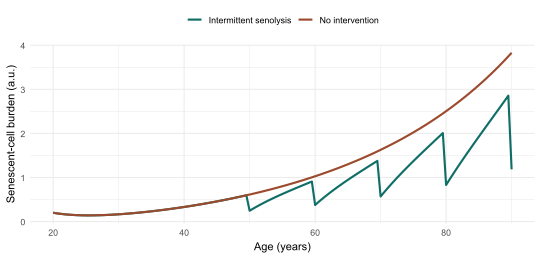
This double-edgedness is also the field’s central practical problem, and Figure 4.1 makes the dynamics concrete. Because senescent-cell burden reflects a balance between production (which rises with age) and immune clearance (which falls), burden accumulates with accelerating speed in later life — and a periodic “hit-and-run” senolytic clearance, rather than continuous suppression, can hold it down, the same intermittent-dosing logic that recurs in Section 8.2.

Show the simulation code
library(ggplot2)

ages <- seq(20, 90, by = 0.5)
dt   <- 0.5

prod_rate  <- function(a) 0.02 + 0.0009 * (a - 20)^1.4          # production rises with age
clear_rate <- function(a) pmax(0.03, 0.22 - 0.0024 * (a - 20))  # clearance falls with age

simulate <- function(senolysis = FALSE, start = 50, every = 10, frac = 0.6) {
  B <- numeric(length(ages)); B[1] <- 0.2
  pulse_ages <- seq(start, 90, by = every)
  for (i in 2:length(ages)) {
    a  <- ages[i - 1]
    dB <- prod_rate(a) - clear_rate(a) * B[i - 1]
    B[i] <- B[i - 1] + dB * dt
    if (senolysis && ages[i] %in% pulse_ages) B[i] <- B[i] * (1 - frac)
  }
  B
}

df <- rbind(
  data.frame(age = ages, burden = simulate(FALSE), regimen = "No intervention"),
  data.frame(age = ages, burden = simulate(TRUE),  regimen = "Intermittent senolysis")
)

ggplot(df, aes(age, burden, colour = regimen)) +
  geom_line(linewidth = 1) +
  scale_colour_manual(values = c("No intervention" = "#9C4A2E",
                                 "Intermittent senolysis" = "#0F6E66")) +
  labs(x = "Age (years)", y = "Senescent-cell burden (a.u.)", colour = NULL) +
  theme_minimal(base_size = 11) + theme(legend.position = "top")
Figure 4.1: Senescent-cell burden across the lifespan, simulated. Burden is modelled as a balance between production (rising with age, as damage accumulates) and immune clearance (falling with age, as immunity wanes); the net effect is an accelerating accumulation in later life (red). Periodic senolytic clearance from age 50 (teal) — removing a fraction of senescent cells every decade rather than suppressing them continuously — holds the burden far below the baseline. The sawtooth shape is the point: senolysis is naturally an intermittent, ‘hit-and-run’ therapy, echoing the pulsed-dosing logic discussed in Section 8.2.
CautionCaveat — senescence is not simply the enemy

The narrative of “clear the senescent cells and rejuvenate” is seductive and partly true, but the double-edged biology warns against zeal. Senescent cells are needed for wound healing and tumour suppression, and indiscriminate or ill-timed elimination can impair repair and, in some tissues and disease models, do harm. There is, moreover, no single universal marker of senescence — the state is heterogeneous, and the consensus effort to define it carefully (Gorgoulis et al., 2019) exists precisely because over-confident identification has muddied the literature. A therapy that targets “senescent cells” must specify which ones, where and when; the promise is real, but it is not a blunt instrument.

4.3 Inflammageing: the slow fire

Follow the senescent cell’s secretions outward, and the third hallmark of this chapter comes into view. Inflammageing — a term coined by Claudio Franceschi — is the chronic, low-grade, sterile inflammation that rises with age in the apparent absence of any infection (Franceschi et al., 2000). Recognised as a distinct hallmark in 2023, it is the integrative endpoint of much that this chapter and the last have described.

Its sources are several and converging. The SASP of accumulating senescent cells is one; others include molecular debris and damage signals (DAMPs) released by stressed and dying cells, the cytosolic DNA of derepressed transposable elements sensed through the cGAS–STING pathway introduced in Chapter 3, the activation of the inflammasome, the age-related remodelling of the immune system known as immunosenescence, and signals from a disrupted microbiome. The consequence is a systemic inflammatory tone that is now among the most reliable correlates of biological ageing and a shared contributor to cardiovascular disease, neurodegeneration and frailty; circulating markers such as interleukin-6 are robust predictors of mortality and multimorbidity (Ferrucci & Fabbri, 2018). Inflammageing is, in this sense, a plausible “common soil” in which several age-related diseases grow — exactly the kind of upstream target the geroscience hypothesis of Chapter 1 was framed to find.

CautionCaveat — is inflammageing even universal?

A recent finding should temper any treatment of inflammageing as a fixed biological law. Comparing four populations — two industrialised (an Italian and a Singaporean cohort) and two non-industrialised (the Tsimane of the Bolivian Amazon and the Orang Asli of Peninsular Malaysia) — a 2025 study found that the familiar inflammageing signature, and its link to age and to age-related disease, held in the industrialised groups but largely vanished in the others, where inflammation tracked infection rather than age (Franck et al., 2025). The authors’ conclusion is striking: inflammageing “in its known form” may be substantially a by-product of industrialised lifestyles and environments — an evolutionary mismatch — rather than a universal feature of human ageing (López-Otín & Kroemer, 2024). The lesson generalises well beyond inflammation, and the book returns to it in Section 11.1: a biomarker validated in one population, however carefully, is a claim about that population until shown otherwise. Universality must be demonstrated, not assumed.

4.4 Stepping back: a map of the hallmarks across a lifespan

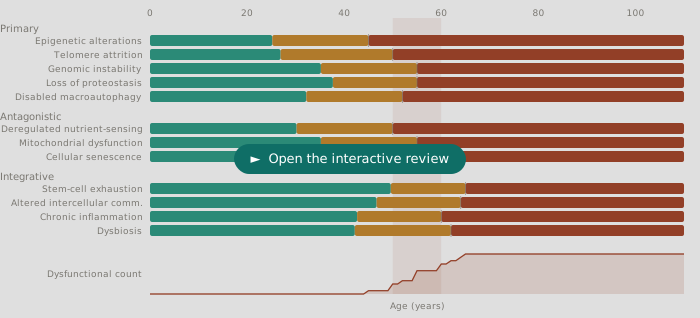
Having followed the hallmarks through three chapters, it is worth seeing the whole picture at once. Figure 4.2 lays the twelve side by side across a human lifespan, each moving from a low or protective phase into a dysfunctional one. Read together, they reveal what a chapter-by-chapter treatment cannot: that the primary causes drift upward early and gradually, that the antagonistic processes are protective before they turn, and that the integrative consequences cross into dysfunction late and close together — a clustering that complex-systems models read as a loss of resilience, and that the figure marks as a correction-compatible window: the interval in which restraining a subset of these processes might still hold the whole system back from a harder-to-reverse transition. It is a heuristic, not a measurement — the hallmarks are quantified at incommensurable scales and largely from cross-sectional data — but as a map of order, rate and synchrony it sharpens the question Part III now takes up: not merely which hallmark to target, but when.

Preview of the interactive review: twelve hallmark tracks across the lifespan, coloured by phase, with a dysfunctional-count track and a shaded correction-compatible window.

Figure 4.2: The hallmarks of ageing across a human lifespan: an interactive review (click to open in a new tab). Each track follows one hallmark from a low or protective phase (teal), through a rising phase (amber), into a dysfunctional one (rust); the shaded band is the correction-compatible window — the interval in which correcting a subset of dysfunctions may still restrain the whole, before the synchronised loss of resilience. A qualitative heuristic, not measured data.

4.5 From the worn-out cell to the worn-out machine

We have followed a single cascade across three tiers of the hallmarks framework: a primary clock running down at the chromosome’s ends, an antagonistic state that saves cells from cancer and then poisons the tissue around them, and an integrative inflammation that may be less universal than its prominence suggests. At each step the same caution recurred — that these processes are protective before they are pathological, so that the obvious intervention is rarely the safe one, a theme that will shape the therapeutic chapters of Part III.

But why do telomeres fray faster in some lives than others, why do cells tip into senescence, and what feeds the inflammation once it starts? The answers lead inward, to the cell’s metabolism and its systems of quality control — how it senses nutrients, folds and disposes of its proteins, and recycles its own worn parts. These are the processes whose decline underlies much of what we have just described, and whose deliberate manipulation, through the oldest and most reproducible of all longevity interventions, opens the next chapter.