The most useful framework for the closing question comes, unexpectedly, from a thinker who spent a career arguing against radical enhancement and has lately allowed that there are conditions under which it might be required. The argument turns on two ideas. The first is species relativism: the claim that judgements of value are made relative to the kind of being that makes them, so that what counts as a good life for a radically enhanced descendant need be neither better nor worse than what counts as a good life for an unenhanced human, only different, and incommensurably so (Agar, 2010). The second is the Principle of Humanity, advanced in the context of a speculative argument about human settlement beyond Earth but stated as a general constraint: when choosing among enhancements, we should defer to the considered judgements of those best placed to know what is valuable about being human as we now are — the unenhanced — and should, in case of doubt, prefer less enhancement to more, the reversible to the irreversible, the moderate to the radical (Agar, 2025).
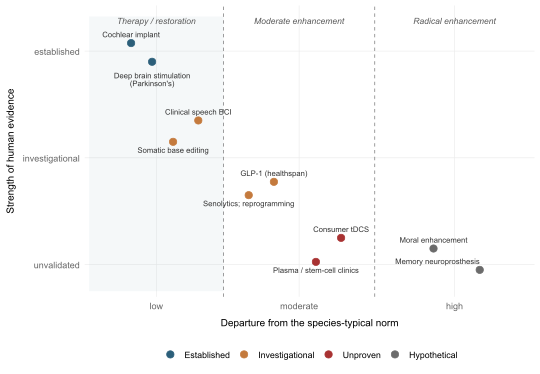
Applied to ageing, this framework cuts cleanly, and in two directions. Against the transhumanist and the commercial overreach, the Principle of Humanity counsels exactly the conservatism the evidence already recommends: a presumption against the radical, the irreversible and the unvalidated, and a deference to the considered judgement that there is something in a finite, embodied, species-typical human life worth not trading away for a speculative upgrade. The marketplace of borrowed credibility, the memory prosthesis, the pursuit of an engineered post-humanity — these are where the principle bites. But the same framework largely exonerates the central project of the preceding parts. Postponing the decline of late life, on the therapy/enhancement boundary inherited from the previous chapter, is overwhelmingly an exercise in restoration: it returns the ageing organism toward a function it once had, rather than pushing it beyond the human maximum. It sits in the lower-left quadrant of Figure 15.1, among the therapies, not the radical enhancements. The Principle of Humanity does not condemn geroscience; it condemns the conflation of geroscience with a programme to remake the species, and it supplies the criterion by which the two can be told apart — the criterion the marketplace works hard to blur.
The somatic–germline distinction drawn in the previous chapter maps onto this conclusion with some precision. Somatic restoration — the senolytic, the partial reprogramming, the in vivo base edit confined, as in the first treated infant, to the cells of one body and one life (Musunuru et al., 2025) — is the modest, defensible centre of the field, the place where the Principle of Humanity offers no objection because no remaking of the human kind is in train. Heritable, germline, species-level modification is where the principle’s caution becomes a brake, because there the choice is made on behalf of beings who cannot be consulted and whose nature is being set rather than repaired. The line that ethics drew in Chapter 14 is the same line philosophy draws here, approached from the other side: the postponement of an individual’s decline is one thing, the redesign of the species is another, and the entire weight of the argument falls on keeping them distinct.
A residue remains, one the consolation traditions identified at the outset. Even granting that geroscience is therapy and not radical enhancement, even granting that a postponed decline is a restoration and not a transgression, the Makropulos question does not dissolve. Whether a substantially longer life is a substantially better one is not settled by showing that it is medically permissible to seek it; that question turns, as Williams and his critics agree even as they disagree about the answer, on what those added years would contain and on whether the self that lived them would still be one for whom things could matter (Fischer, 2024; Williams, 1973). The traditions that made finitude a fixed point were answering this question — how to live well as a being with a term — and the unsettling of the frame does not retire their question but sharpens it. A creature who can adjust the term must decide what the term is for, and no amount of biology will make that decision for it. The science of the preceding parts has handed the species a dial it did not have. It has not told it where to set it, and the disciplines that might — the ones surveyed in these pages and the ones that lie beyond them — have only begun the work.
The two modern accounts of death’s badness frame that open question precisely. The deprivation account holds that a death is worse the more good life it forecloses, which seems to license the indefinite postponement of decline; the Makropulos argument holds that the good a long life forecloses may itself run out, so that past some point a further postponement deprives one of nothing worth having. On inspection they do not contradict each other. The deprivation account explains why averting an early or a decline-ridden death is a benefit; the Makropulos argument explains why that benefit need not extend without limit, and why the operative question is not how long but how much of what matters a longer life would hold. A geroscience that compresses morbidity and restores good years to a life that disease would have cut short is, on both accounts, doing good. A project aimed instead at sheer duration, indefinitely prolonged, would have to answer the harder question the ancients posed and the moderns have not closed — and would find that biology, having surrendered the dial, falls silent exactly where the question turns philosophical.
Agar, N. (2010). Humanity’s end: Why we should reject radical enhancement. MIT Press.
Agar, N. (2025). How going to space changes the debate about radical human enhancement.
Bioethics.
https://doi.org/10.1111/bioe.70071
Aurelius, M. (2002). Meditations (G. Hays, Tran.). Modern Library.
Beauvoir, S. de. (1970). La vieillesse. Gallimard.
Berk, K. (2024). Simone de Beauvoir on the curse of immortality. Simone de Beauvoir Studies, 35(1-2), 105–124.
Boekstein, N., & al., et. (2023). Defining a longevity biotechnology company.
Nature Biotechnology,
41(8), 1053–1055.
https://doi.org/10.1038/s41587-023-01854-0
Boorse, C. (1977). Health as a theoretical concept.
Philosophy of Science,
44(4), 542–573.
https://doi.org/10.1086/288768
Bostrom, N. (2005).
The fable of the dragon-tyrant. Essay (online).
http://www.nickbostrom.com/fable/dragon.html
Buchanan, A., Brock, D. W., Daniels, N., & Wikler, D. (2000).
From chance to choice: Genetics and justice. Cambridge University Press.
https://doi.org/10.1017/CBO9780511806940
Demaria, M. (2025). Longevity clinics: Between promise and peril.
Aging,
17(10), 2452–2454.
https://doi.org/10.18632/aging.206330
Di Cesare, D. (2018). Heidegger and the jews: The black notebooks (M. Baca, Tran.). Polity Press.
Epicurus. (1994). Letter to menoeceus. In B. Inwood & L. P. Gerson (Eds.), The epicurus reader (pp. 1–6). Hackett.
Faye, E. (2009). Heidegger: The introduction of nazism into philosophy in light of the unpublished seminars of 1933–1935 (M. B. Smith, Tran.). Yale University Press.
Fischer, J. M. (2024). Why immortality could be good.
International Journal of Philosophical Studies,
32(1), 78–100.
https://doi.org/10.1080/09672559.2023.2286537
Gems, D., & Magalhães, J. P. de. (2024). Inflated expectations: The strange craze for translational research on aging.
EMBO Reports,
25(9), 3748–3752.
https://doi.org/10.1038/s44319-024-00226-2
Hadot, P. (1995). Philosophy as a way of life: Spiritual exercises from socrates to foucault (M. Chase, Tran.). Blackwell.
Haker, H., Schweiker, W., Hamalis, P., & Renaud, M. (2021). Religious responses to radical life extension: Comparative perspectives.
Journal of the Society of Christian Ethics,
41(2), 7–28.
https://doi.org/10.1353/scj.2021.0002
Hamzelou, J. (2025). Longevity clinics around the world are selling unproven treatments. MIT Technology Review.
Harris, J. (2016).
How to be good: The possibility of moral enhancement. Oxford University Press.
https://doi.org/10.1093/acprof:oso/9780198707592.001.0001
Heidegger, M. (1962). Being and time (J. Macquarrie & E. Robinson, Trans.). Blackwell.
Kang, J., Lee, H., Yu, S., et al. (2024). Effects and safety of transcranial direct current stimulation on multiple health outcomes: An umbrella review of randomized clinical trials.
Molecular Psychiatry,
29(12), 3789–3801.
https://doi.org/10.1038/s41380-024-02624-3
Littlejohn, K. T., Cho, C. J., Liu, J. R., et al. (2025). A streaming brain-to-voice neuroprosthesis to restore naturalistic communication.
Nature Neuroscience,
28(4), 902–912.
https://doi.org/10.1038/s41593-025-01905-6
Lucretius, T. L. C. (1951). On the nature of things (R. E. Latham, Tran.). Penguin Classics.
Lyreskog, D. M., & McKeown, A. (2022). On the (non-)rationality of human enhancement and transhumanism.
Science and Engineering Ethics,
28.
https://doi.org/10.1007/s11948-022-00410-4
Musunuru, K. et al. (2025). Patient-specific in vivo gene editing to treat a rare genetic disease.
New England Journal of Medicine.
https://doi.org/10.1056/NEJMoa2504747
Nagel, T. (1970). Death.
Noûs,
4(1), 73–80.
https://doi.org/10.2307/2214297
Olshansky, S. J., Willcox, B. J., Demetrius, L., & Beltrán-Sánchez, H. (2024). Implausibility of radical life extension in humans in the twenty-first century.
Nature Aging,
4(11), 1635–1642.
https://doi.org/10.1038/s43587-024-00702-3
Safranski, R. (1998). Martin heidegger: Between good and evil (E. Osers, Tran.). Harvard University Press.
Savulescu, J., & Kahane, G. (2009). The moral obligation to create children with the best chance of the best life.
Bioethics,
23(5), 274–290.
https://doi.org/10.1111/j.1467-8519.2008.00687.x
Scheffler, S. (2013).
Death and the afterlife (N. Kolodny, Ed.). Oxford University Press.
https://doi.org/10.1093/acprof:oso/9780199982509.001.0001
Seneca, L. A. (2004). Letters from a stoic: Epistulae morales ad lucilium (R. M. Gummere, Ed.; R. Campbell, Tran.). Penguin Classics.
Sparrow, R. (2022). Human germline genome editing: On the nature of our reasons to genome edit.
The American Journal of Bioethics,
22(9), 4–15.
https://doi.org/10.1080/15265161.2021.1907480
Trawny, P. (2015). Heidegger and the myth of a jewish world conspiracy (A. J. Mitchell, Tran.). University of Chicago Press.
Willett, F. R. et al. (2023). A high-performance speech neuroprosthesis.
Nature,
620(7976), 1031–1036.
https://doi.org/10.1038/s41586-023-06377-x
Williams, B. (1973). The Makropulos case: Reflections on the tedium of immortality. In Problems of the self: Philosophical papers 1956–1972 (pp. 82–100). Cambridge University Press.